Cake cost calculator vs cake price calculator
A cake cost calculator tells you what the cake costs you. A cake price calculator tells you what to charge the customer. You need both numbers, and they are not the same.
Cost is the floor: ingredients, packaging, labor, and overhead. If you charge below that number, you are paying to bake. Price is the business number: cost plus profit margin, rounded into something you can quote clearly.
That is why the calculator separates the lines instead of giving one mysterious answer. You can see whether the problem is expensive ingredients, too many unpaid hours, overhead you forgot to count, or a margin that is too thin to keep the business alive.
What belongs in cake costs
Cake costs are everything you spend before profit exists. If the order makes you buy it, use it, drive for it, or spend time on it, it belongs in the cake cost calculator.
Once those costs are visible, the price decision gets easier: add margin, round the total, then turn it into a quote the customer can understand.
| Cost line | Count this | Easy to miss |
|---|---|---|
| Ingredients | Cake, filling, frosting, fondant, colors, toppers | Small decorations and test batches. |
| Structure and packaging | Board, box, dowels, supports, inserts, labels | The tall box or drum board for one custom order. |
| Labor | Shopping, baking, cooling, filling, decorating, cleanup, messaging | The customer back-and-forth before the oven turns on. |
| Overhead and delivery | Power, water, mixer wear, fuel, delivery supplies | A short delivery that still takes 40 minutes round trip. |
How the formula works
The formula is short: ingredients, plus your hours times your hourly rate, plus a share of overhead, plus a profit margin. That total is your price. Here is what each piece means in plain words.
Ingredients are everything that leaves your kitchen with the cake: flour, butter, eggs, fondant, and the board and box it travels on. Count generously, because the little things like food coloring and dowels add up.
Labor is the line bakers undercharge most. If a cake takes 4 hours and you charge $40, you paid yourself $10 an hour before you bought a single egg. Pick an hourly rate you would accept from an employer, then count every hour: baking, decorating, cleanup, and the back-and-forth with the customer.
Overhead is the quiet cost of running an oven in your home: power, water, packaging supplies, and wear on your mixer and pans. You do not need an accountant for this, just a small share added to every order so those costs stop coming out of your pocket.
Margin is profit on top, the part that lets you replace a broken pan or take a slow month without panic. Without it you have a job that pays exactly its own costs, not a business.
A worked example: a 2-tier birthday cake, 40 servings
Cupcake cost calculator: same formula, smaller batch
For cupcakes, use the same calculator but think in dozens. Add the batter, frosting, liners, box, inserts, toppers, and your decorating time for the whole batch. Then set servings to 12 for one dozen or 24 for two dozen.
A plain dozen might have $8 in ingredients and packaging, 1.5 hours of labor, and a modest margin. A decorated dozen with piped florals, fondant toppers, or individual colors can take twice as long while using almost the same batter. That is why cupcake pricing should count labor first, not flour first.
If you sell cookie boxes, brownies, macarons, cinnamon rolls, or market bundles, the same baked goods pricing calculator logic still works: batch cost, batch labor, overhead share, margin, then divide by the units you sell.
Five pricing mistakes that keep bakers broke
Most underpricing is not bad math. It is one of these five habits.
- Copying grocery store prices. A supermarket sheet cake is made at industrial scale by salaried staff. Your custom cake is a different product, so price it like one.
- Forgetting boards, boxes, and delivery. A $6 drum board and a 40-minute round trip are real costs. If they are not in the price, they come out of your profit.
- Charging the same for simple and sculpted. A buttercream round and a tiered fondant design with sugar flowers can differ by six hours of work. Your price should say so.
- Taking no deposit. When a date changes or an order cancels late, you eat the ingredients and the work you turned away. A deposit makes the date real.
- Never raising prices for repeat customers. Butter goes up, your skills go up, and a fair bump is expected. Grandfathered prices quietly shrink your hourly rate every year.
When the price becomes a quote
The calculator gives you a number. The harder step is saying it out loud. When a customer asks for a custom cake on Confita, you answer with a private link that carries the price, the deposit, and your payment details, so the awkward money conversation becomes one clean page your customer can open anytime.
That part is what Confita charges for: Free setup lets you build and preview first; Pro is $4.99/month after a 7-day trial when you publish your shop link and take live orders. The calculator stays free either way.
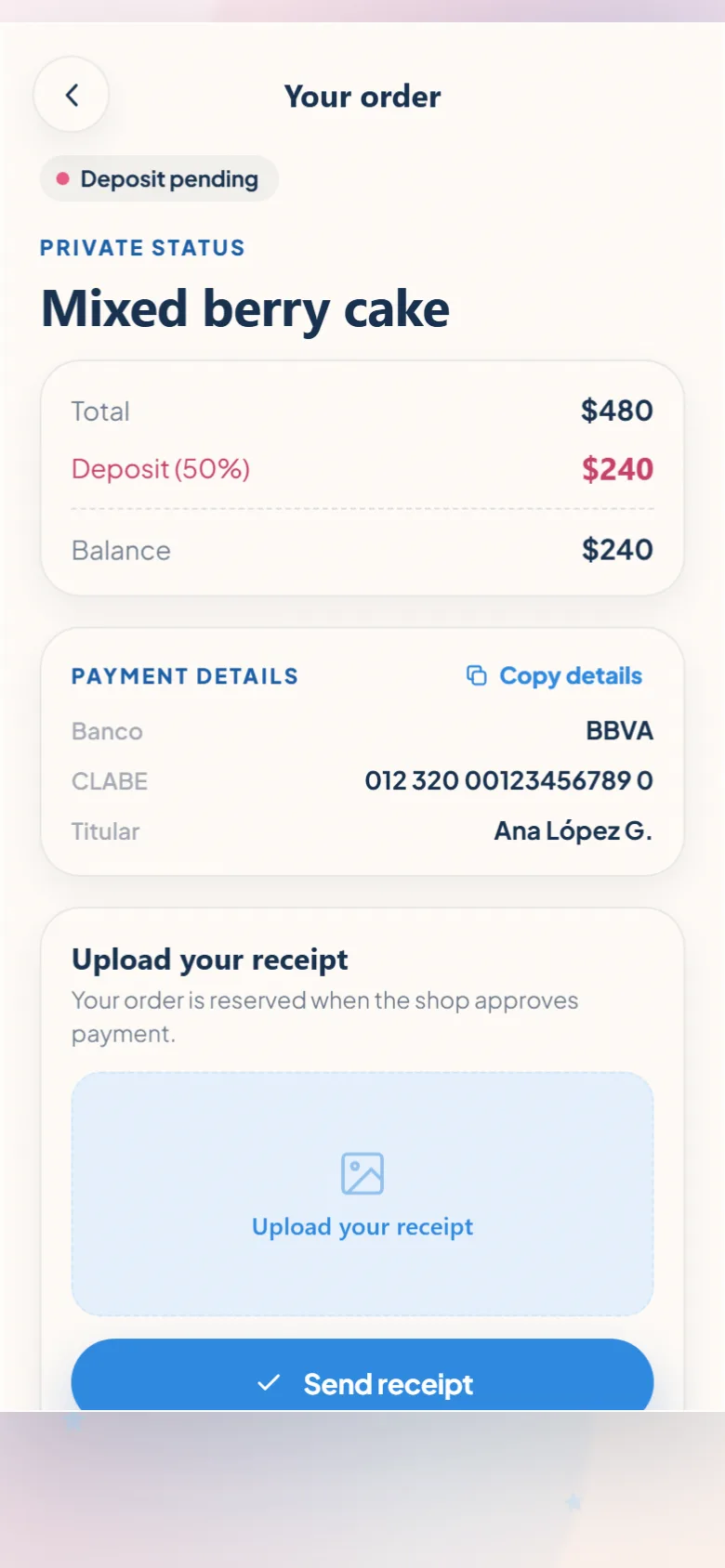
After the calculator: quote and deposit
A good price still needs a clean next step. These two pages turn the number into a customer-ready message and a reserved date.
Put your prices on a real shop link
List your cakes with prices, sizes, and your order questions on one link customers open in the browser. Shop setup is free; the Pro trial starts when you activate live features.
Frequently asked questions
How do I price a homemade cake?
Add up your ingredients, your hours times an hourly rate you would actually accept, and a small share of your kitchen overhead, then add a profit margin on top. The calculator above walks that exact formula with your own numbers.
What costs should I include in a cake cost calculator?
Include ingredients, filling, frosting, packaging, cake board, box, supports, toppers, delivery supplies, kitchen overhead, and every hour of labor. The cost of making a cake is more than flour and butter.
How much should I charge for a dozen cupcakes?
Run the same formula: ingredients for twelve, your decorating hours at your rate, overhead, and margin. For decorated dozens, many US home bakers land between $30 and $45 depending on how detailed the design is, but your hours and your local market set the real number.
What is a fair hourly rate for cake decorating?
Use your local service wage as the floor: if cafes near you pay $18 an hour, your skilled decorating should never pay less. Rates of $18 to $25 an hour are common for home bakers, and experienced decorators charge more.
Why are custom cakes so expensive?
Because they are skilled labor, not groceries. A custom cake carries hours of baking, decorating, and customer back-and-forth, plus ingredients, a board, a box, and a share of kitchen costs. When a cake looks expensive, it usually means the decorator finally priced the hours inside it.