The template
Tap the button to copy every field as plain text, then paste it into a document, a message, or your form builder.
Every field, and why it earns its place
Contact comes first because a perfect order with an unreachable customer is just an expensive practice cake. Get a name and the phone number they actually answer, and settle pickup or delivery now, with the full address if you are the one driving.
The date is your gate, so it sits near the top. Check your calendar before you read another line: if the date is full, you can decline kindly in one message instead of falling in love with a design you cannot make. The time matters too, because a 9 a.m. pickup and a 6 p.m. pickup are two very different mornings.
The money fields kill awkward surprises. A budget range tells you whether the customer is imagining a $60 cake or a $300 cake before you sketch anything. The deposit line, with its due date, turns a conversation into a booking. The balance line means nobody is doing math in a doorway on pickup day.
The design fields, flavor, filling, frosting, theme, colors, and the inscription, exist so you never decorate from memory of a phone call. Ask for the inscription word for word, spelling included. A misspelled name in buttercream is a mistake the form catches so you never have to.
Allergies get their own line because the question asked out loud gets forgotten, and the question written down protects both of you.
Wedding cakes: the extra questions
A wedding cake order form is the same form with four more questions, and each one prevents a specific bad day.
- Tasting date: agree on it up front and treat it as the real appointment. Most wedding cakes are booked at the tasting, not in the first message.
- Tiers and the servings split: a couple may want a three-tier look but only 80 eaten servings. Ask how many tiers, how many servings, and whether a kitchen sheet cake covers the gap. That answer can move the price by $150 or more.
- Delivery and setup window: venues give vendors a time slot. Ask when you can arrive, how long you have, and whether there are stairs or a long carry. Stacking tiers in a hot hallway is how disasters start.
- Venue contact: get the coordinator’s name and phone number. On the day, your customer is busy getting married, and you need someone who answers.
Cupcakes and weekly bake sheets
Cupcake orders and weekly bakes do not need the full custom-cake interview. Strip the form down to a grid: each flavor as a row, a quantity box beside it, and a unit price so the customer can total their own order. A dozen vanilla at $30, half a dozen lemon at $16, done.
For regulars, swap the free-text time for printed pickup windows like “Friday 4 to 6 p.m.” and “Saturday 9 to 11 a.m.”. You batch your baking, customers stop asking when things are ready, and the same sheet works every single week. Keep the allergy line even on the simple version. It earns its spot everywhere.
Deposits and a simple invoice line
A deposit is the sentence that makes an order real. Use plain wording on the form: “A 50% deposit reserves your date. Your date is not held until the deposit arrives.” Said that way it is not a policy fight, it is just how booking works, the same as any salon or photographer.
When money moves, write a receipt, even a simple one. It should show the date, what was ordered, the full price, the deposit paid, the balance due and when, and how that balance will be paid. One clear line like “Deposit $80 received March 3, balance $80 due at pickup April 12” has settled more disputes than any contract clause. If a customer asks for an invoice, that same information with your business name at the top is a perfectly good one.
Paper form vs Google Form vs live shop link
All three work. The honest question is where your orders come from and how much follow-up you want to do after the form is filled in.
Paper is unbeatable at a market table. Google Forms is free and genuinely fine for collecting answers, you will just handle prices, photos, and payment in follow-up messages. A shop link does those three things in the same place the customer already is.
| What matters | Paper form | Google Form | Live shop link |
|---|---|---|---|
| Cost | Printing only | Free | $4.99/month after a 30-day trial |
| Where it shines | Markets and in-person orders | Quick links from social media | Your bio link, open all week |
| Shows prices and photos | Only what you print | Questions only, no priced menu | A real menu with photos and prices |
| Reference photo uploads | Customer hands you a phone | Requires a Google sign-in | Built in, no account needed |
| Deposit and payment details | Handled in person | Followed up by message | Carried in a private quote link |
The same form, living on your products
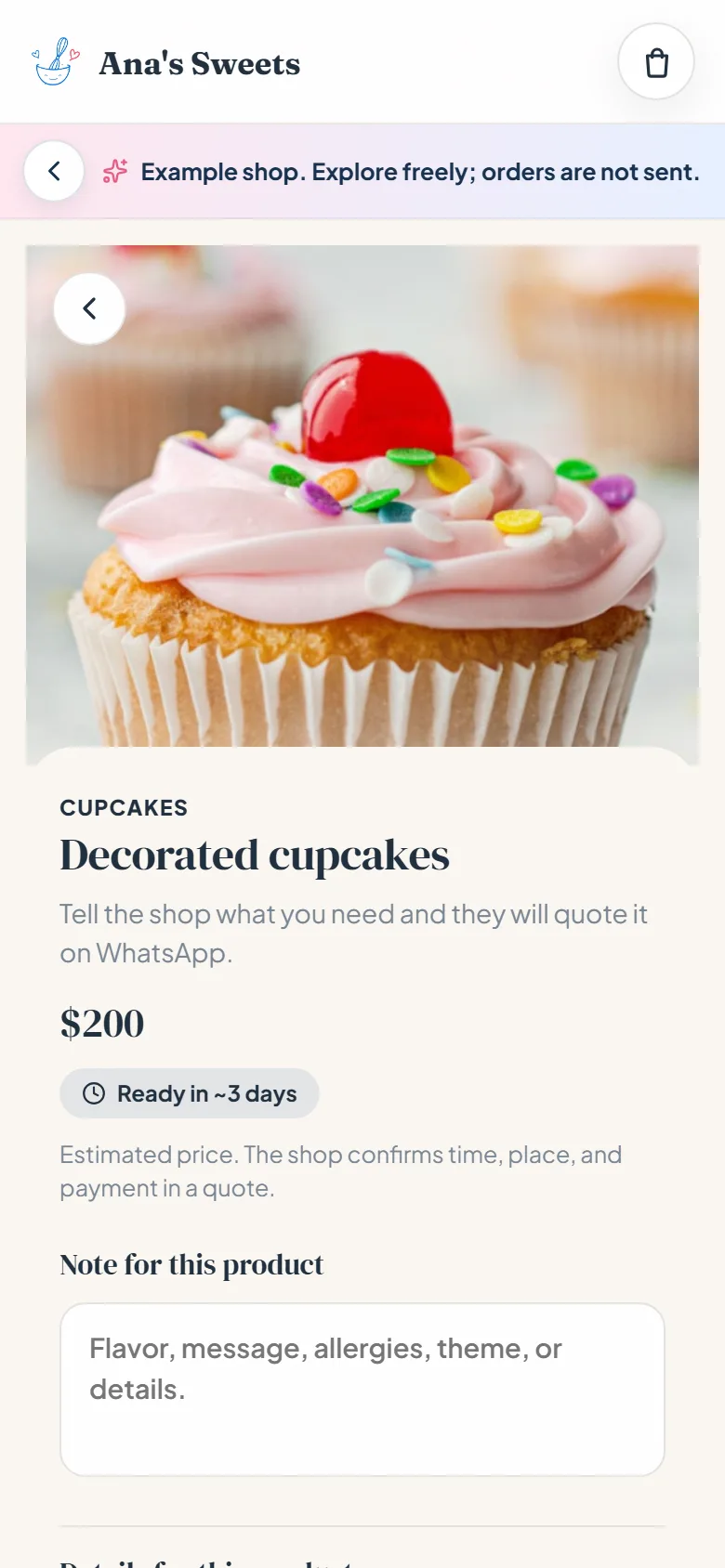
On Confita, these fields stop being a separate form. Each product carries its own questions, servings, flavor, inscription, allergies, plus a reference image upload, so customers answer while they order. The request lands in your inbox complete, with nothing to copy from a form into a chat thread.
Run this form as a real shop
Confita turns these fields into your product questions. 30 days free, no card today.
Frequently asked questions
What should a cake order form include?
Contact details, the event date and pickup time, servings, flavor, filling and frosting, theme and colors, the exact inscription, allergies, a budget range, and your deposit and payment terms. The template above includes every one of those fields with wording ready to copy.
Is there a free cake order form template?
Yes, the one at the top of this page. Copy the fields as plain text, paste them into a document or a message, or print the sheet for in-person orders. No signup or email is needed.
How do I make a cake order form in Google Forms?
Create a new form, add the fields above as short-answer and multiple-choice questions, and share the link. It collects answers well, but it cannot show prices or take a deposit, and the photo upload question requires customers to sign in to Google, so plan to handle money and reference images in follow-up messages.
Should a cake order form take deposits?
Yes, for any cake that takes real time. A 50% deposit is the common standard: it reserves the date, covers ingredients if plans change, and filters out the inquiries that were never going to order. Print the terms on the form so they read as policy, not negotiation.