The formula, up front
Price your cake as ingredients, plus labor, plus overhead, plus profit. Four lines. Here is what each one means in plain words.
Ingredients are everything that leaves your kitchen with the cake. Flour, butter, eggs, and fondant, sure, but also the board it sits on, the box it travels in, and the dowels holding up the second tier.
Labor is your hours multiplied by an hourly rate you would accept from an employer. Not just the fun decorating hours. Shopping, baking, cooling, stacking, cleanup, and the back-and-forth with the customer are all part of the job.
Overhead is the quiet cost of running a bakery out of your house: the oven’s electricity, the extra dish loads, parchment and piping bags, your cottage food permit, and the slow wear on your mixer. Estimate it once a month and give every order a small share.
Profit is what is left after the cake pays for itself and pays you. It replaces a cracked pan, absorbs a slow month, and someday buys a bigger oven. A business with no margin is a hobby with invoices.
Costing ingredients without losing your mind
Nobody wants to weigh flour and multiply by a price per gram for every order. You do not have to. Cost each recipe once, write the number on the recipe card, and reuse it until prices drift.
Here is the once part, with real numbers. A 5-pound bag of flour around $4 holds about 18 cups, so a recipe using 3 cups costs roughly 65 cents in flour. Butter at $5 a pound is $1.25 a stick. A $3.50 dozen makes each egg about 29 cents. Total the whole recipe that way against your last grocery receipt. Most cake recipes land between $8 and $15 in raw ingredients, more once fondant joins the party.
Then divide by what the batch makes. If one batch of buttercream frosts three cakes, a third of its cost rides on each one. Update the card a couple of times a year when your receipts change, and the math stays a two-minute job forever.
Then add what almost everyone forgets: the non-food costs that leave with the cake. A drum board, a sturdy box, dowels, a ribbon, a label. That is easily $10 or more on a tiered cake, and if it is not in your price, it comes out of your profit.
Labor: the line everyone undercharges
Run this number on your last cake and brace yourself. Say the cake took 4 hours start to finish and you charged $40. Before you subtract a single cup of flour, that is under $10 an hour. Take out $15 of ingredients and a box, and your hands earned about $6 an hour for skilled work.
The trap is treating your time as free because you enjoy the work. But your skill is the product. Anyone can buy flour. People come to you for steady piping, level tiers, and a cake that looks like the picture they sent, and that took years to build.
So pick a rate on purpose and write it down. For US home bakers, $18 to $25 an hour is a common floor, and experienced decorators charge more. Then count all the hours, not just decorating. Quoting, shopping, baking, boxing, and cleanup are the job too.
If the resulting price feels scary, do not quietly lower your rate. Get faster, simplify the design, or let the price stand. A lower rate does not fix the problem; it hides it inside your paycheck.
Overhead and the cottage food extras
Overhead is every cost of running the bakery that no single cake owns: power for a long oven session, water and soap for the mountain of dishes, parchment, foil, gloves, and the day your stand mixer finally gives up. None of it shows up on a recipe card, and all of it is real money.
Cottage food sellers carry a few extra lines, depending on the state: a registration or permit fee, a food-handler course, label printing, liability insurance if you carry it, and booth fees when you sell at markets.
You do not need an accountant for this. Add up a typical month of those costs and divide by the orders you take. If it comes to $60 a month across six orders, that is $10 a cake. Give bigger projects a bigger share, since they hog the oven longer. Precision is not the goal; keeping these costs out of your own pocket is.
A worked example: 2-tier birthday cake, 40 servings
The grocery store is not your competitor
Sooner or later somebody will say it: the grocery store sells a whole sheet cake for $25. Smile, because the comparison is broken.
A supermarket cake is a commodity. It is made at industrial scale by salaried staff, often from frozen components, and the store can price it low because it is one item among thousands. Your cake is custom work, made once, for one person, in their colors, for their date. The two products share a word and nothing else.
The customer who wants a $25 cake was never your customer. The parent ordering a dinosaur cake for a fifth birthday is not cross-shopping the freezer aisle. Price against the grocery store and you do not win their shoppers. You just donate your weekend.
Quoting custom work
A posted price works for repeatable items: standard sizes, set flavors, cookies by the dozen. Custom work needs a different move, because the design changes the labor far more than the ingredients. A 3-hour buttercream round and a 9-hour sculpted cake can use nearly the same flour and sugar.
The pattern that works: publish starting prices so people can self-filter, something like custom 8-inch cakes from $85, then quote the real number once you have the details that drive the hours: servings, design, the date, and ideally a reference photo. Quoting from details protects you from pricing a six-hour cake off a two-line message.
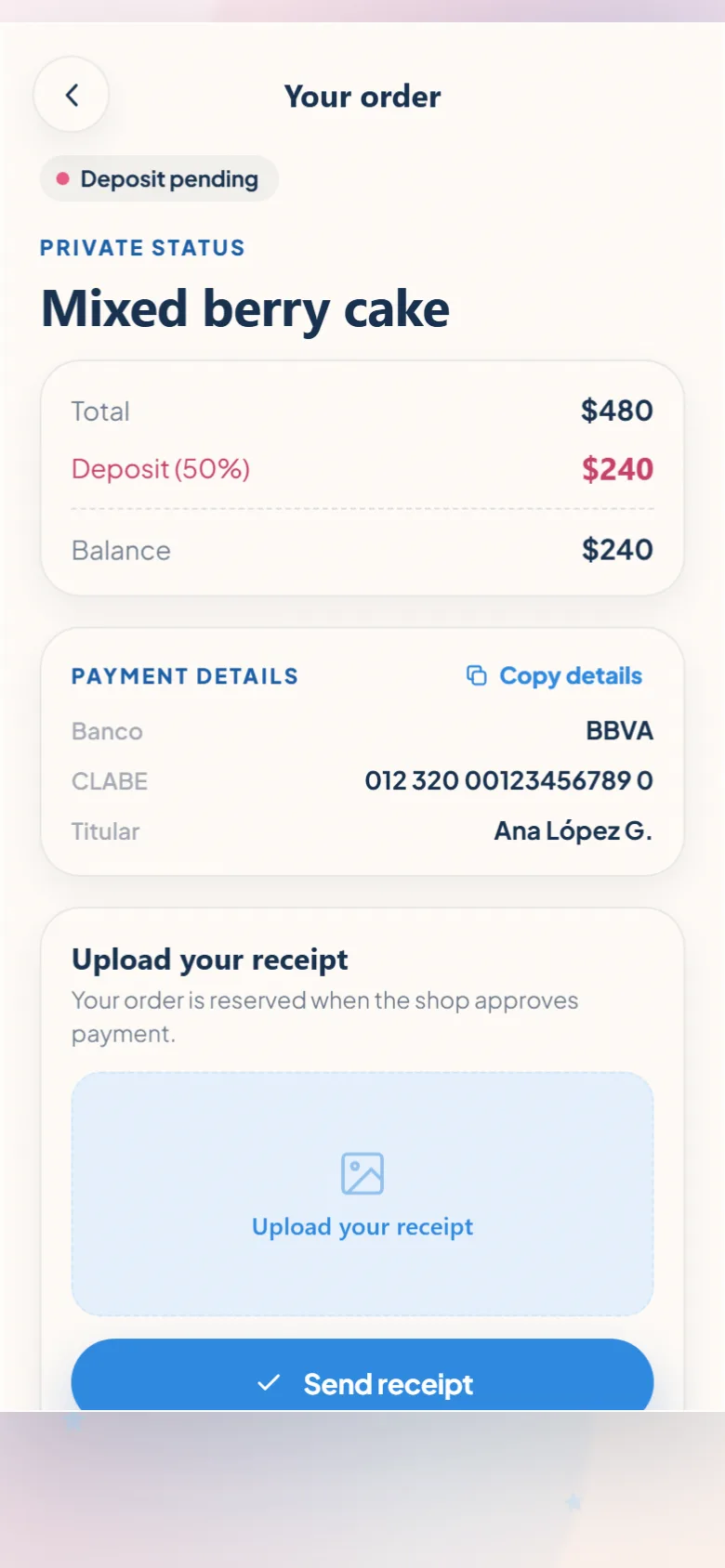
And take a deposit on every custom order. Half is standard. A reserved Saturday is inventory, and a 50% deposit makes the booking real, filters out the maybes, and covers your ingredients if plans change late. Put it in writing.
A quote your customer can act on
The hardest part of quoting is not the math. It is sending the number, the deposit, and your payment details without retyping them into a chat thread at 11 pm. With Confita, you answer a request with a private quote link that carries the price, the deposit amount, your payment instructions, and a spot for the customer to upload their payment receipt.
One link does the awkward part, the customer always knows where the order stands, and you keep 100% of the sale. Confita is $4.99/month flat with no commission, with free shop setup and a Pro trial when you activate.
Do this math in two minutes
The free calculator runs ingredients, hours, overhead, and margin with your own numbers. No email, no signup.
Frequently asked questions
How much should I charge for a cake?
Add your ingredients including the board and box, your hours at a rate you would accept from an employer, a share of monthly overhead, and a profit margin on top. The worked example on this page, a 2-tier cake serving 40, comes out to $194, about $4.85 per serving. Your numbers will differ, but the formula holds.
How do you calculate cake prices?
Cost each recipe once from your grocery receipt and write it on the recipe card. Multiply your total hours, including cleanup and customer messages, by your hourly rate. Add a per-order share of overhead, then add 15 to 25 percent margin. After the first time, pricing a new order takes minutes.
Why are custom cakes so expensive?
Because a custom cake is skilled labor, not groceries. Inside the price are hours of baking and decorating, ingredient costs, a board and a box, a share of kitchen overhead, and the years of practice that make the cake match the picture. A cheap custom cake usually means the baker forgot to pay themselves.
Should I charge for cake tastings?
Yes. A tasting box costs you real ingredients and packing time, so most bakers charge a small fee and credit it toward the order if the customer books. That keeps tastings for serious inquiries and stops free samples from quietly eating your margin.