Week one: the legal check
Every US state lets home bakers sell somehow, through what are called cottage food laws. What changes by state is the list of allowed foods, where you can sell them, whether there is an annual sales cap, and what paperwork comes first. Some states want a permit and a kitchen inspection. Others ask for nothing beyond correct labels.
So before you buy boxes or print menus, search your state’s name plus cottage food law and open the page from your state department of agriculture or health. That page is the source of truth. Read the approved food list first: most baked goods qualify because they are shelf-stable, but anything that needs refrigeration, like cheesecake or cream-filled pastries, often does not.
Budget an evening for this, not a month. Confirm your foods qualify, do the food-handler course if your state asks for one, and make one label template with your name and address, ingredients, allergens, and the home-kitchen disclosure most states require. The cottage food guide on this site walks the whole legal picture in more depth.
Decide what you sell first
The instinct is to offer everything you can bake. Resist it. A first menu of 3 to 5 items you can repeat on a weeknight beats a 20-item menu that needs a different grocery run for every order.
Pick a signature item, the thing friends already ask you to bring. One signature plus a couple of supporting items is a real menu: maybe your cinnamon rolls, two cookie flavors by the dozen, and one celebration cake size. Narrow means you photograph each item once, cost it once, and get faster every week, which quietly raises your hourly rate without raising prices.
Custom work can come later, once your quoting process exists. Saying not yet to a sculpted cake request in month one is not lost money. It is dodged chaos.
Price for profit from day one
Price every item with the full formula before you publish it: ingredients including the box and board, your hours at a real hourly rate, a share of overhead like power and packaging, and a profit margin on top.
The trap to avoid is the one almost every new baker falls into. A cake takes 4 hours and gets priced at $40 because that feels like what people would pay. Subtract ingredients and that is under $10 an hour for skilled work. Worse, raising prices later on customers you trained at $40 is much harder than starting right.
You do not have to build a spreadsheet. The free cake pricing calculator on this site runs the whole formula with your numbers, and the cake pricing guide goes deeper on every line. Set your prices once, write them down, and put them in public. A public price list ends haggling before it starts.
Set up your order channel before your first post
Here is what happens after your first popular post. Someone comments asking the price. Someone else DMs about gluten-free. A coworker texts your phone. Your aunt relays an order from her neighbor. Each of those turns into six more messages: what date, what size, which flavors, any allergies, how do I pay you, where do I pick it up.
Six messages times a handful of orders is an evening gone, and one missed detail costs more than time. A wrong pickup date eats a Saturday. A missed allergy answer is far worse than that. This is the part to set up before you promote anything: one place where orders land complete.
Whatever you use, it needs four things: a menu with real prices, the questions you would otherwise ask in chat, your deposit policy in writing, and your pickup windows. A shop link like Confita bundles all four into one link customers open in the browser, with your questions answered and reference photos attached before you ever reply. But even a paper form beats memory.
Your first 10 customers
Skip the ads. Your first customers are people who already trust you: friends, family, coworkers, the parents in your group chat. Announce a soft launch with three photos, your prices, and one pickup date. Friends-and-family orders are real practice for your packaging, your timing, and your nerve when you say the price out loud.
Then pick one local Facebook group or Nextdoor neighborhood and show up weekly, same day, same format: what you are baking, the price, the pickup window, the link. One channel worked consistently beats five channels worked randomly, and neighbors who see you every Thursday start planning around you.
Do not chase viral. A reel with 40 views from people in your zip code is worth more than 40,000 views from people who cannot pick up a cake. Daylight photos, honest prices, and on-time handoffs are what turn the first 10 customers into the next 10.
A realistic first month
Orders arrive complete
This is the seller side of a Confita shop: every request lands in one inbox with the date, the items, the customer’s answers to your questions, and any reference photos already attached. No scrolling three chat apps to rebuild an order.
It costs $4.99/month flat, or $39 a year, with no commission on your sales. Shop setup is free, and the Pro trial starts when you activate live features. Cheap enough to try in month one, easy to drop if it does not earn its keep.
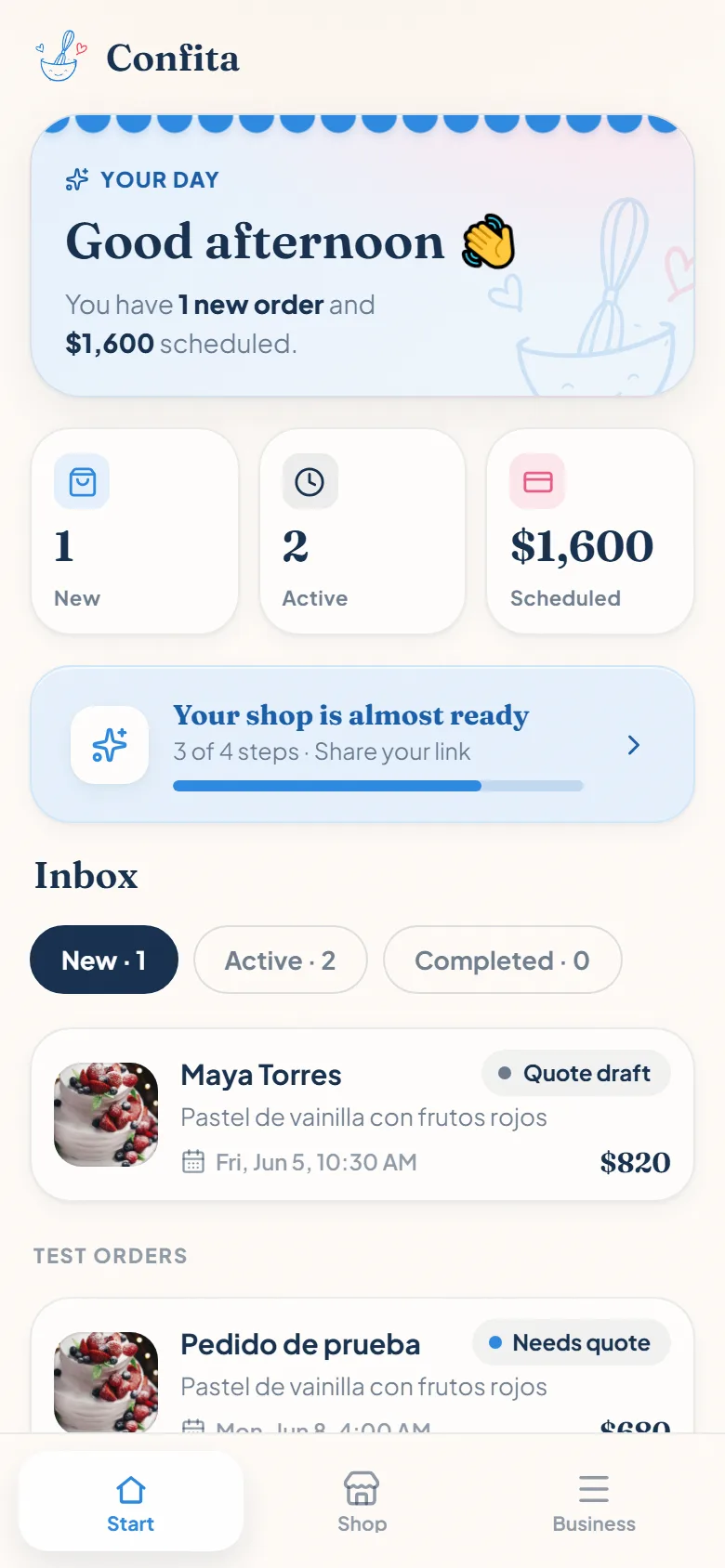
Open your shop before the weekend
Add your 3 to 5 items, your order questions, and your pickup windows in an afternoon. Create the shop free; activate Pro when you want live features.
Frequently asked questions
How do I start a home bakery?
Check your state’s cottage food law first, since it decides what you can sell and what permits you need. Then pick 3 to 5 repeatable items, price them with the full formula including your labor, set up one channel where orders land complete, and soft launch to friends and one local group. Most bakers can do all of that in a few weeks of evenings.
Is a home bakery profitable?
It can be, and pricing decides it. A home bakery has low fixed costs, no rent and no staff, so profit comes down to charging for your hours honestly and keeping fees off your sales. A baker who prices labor into every item and pays a flat fee for tools keeps nearly everything after ingredients. The same sales priced by gut feel can net close to nothing.
What do I need to start selling baked goods from home?
In most states: confirmation that your foods qualify under the cottage food law, any required permit or food-handler course, compliant labels with ingredients and allergens, and one place to take orders and payments. On the equipment side, the oven and mixer you already own are enough to start.
How do I get my first customers?
Start with people who already know you: a soft launch post with photos, prices, and one pickup date. Then post weekly in one local Facebook group or Nextdoor with the same format and your order link. Repetition in one neighborhood beats reach, because your buyers have to live close enough to pick up.