Your real options, honestly
There are five realistic places to sell as a home baker, and you will probably use two or three of them together. None of them is wrong. They just break down at different volumes.
The honest version: DMs feel free but cost the most time per order. Marketplaces bring traffic but take a cut and keep the customer relationship. A shop link costs a few dollars a month and collects the details for you, but you still bring the audience. Most working setups are social for discovery plus one link where every order lands.
| Where | What it costs | What it is good at |
|---|---|---|
| Your own shop link | A flat monthly fee, $4.99 with Confita, 0% commission | Complete orders: prices, questions, deposits, one link in your bio |
| Instagram + Facebook DMs | Free | Discovery and chat; melts down past a few orders a week |
| Local FB groups + Nextdoor | Free | Reaching neighbors who can actually pick up this Saturday |
| Farmers markets | A booth fee per market day | Sampling, cash sales, and meeting your weekly regulars |
| Marketplaces | A commission on every sale, often around 10% | Built-in traffic, but the platform owns the customer |
Why shipping is the wrong first step
Shipping feels like the obvious meaning of selling online, and for most home bakers it is the wrong first step. Cottage food laws in many states limit or forbid shipping, and some restrict you to direct, in-person sales. Check your state’s rules before you promise to mail anything.
Even where shipping is legal, the economics are rough. Boxes, insulation, cold packs, and priority postage can cost more than the bake itself, and one melted-buttercream review hurts more than ten happy pickups help.
Local first is not settling, it is sequencing. Pickup windows at your door, porch delivery within a few miles, a market table once a month. You can sell out a week of capacity without ever printing a shipping label, and you can add shipping later if your state allows it and the math works.
The setup that takes one afternoon
If you already have a phone and a free hour of daylight, the whole setup fits in one afternoon. Five steps, in order:
- Photograph 3 to 5 products near a window in daylight. A phone camera is fine; dim kitchen lighting is the only real enemy.
- Write a real price on every item. A price is a filter that works while you sleep.
- Add the questions you always end up asking anyway: date, servings, flavors, allergies, pickup or delivery.
- Write your deposit policy in one sentence, like a 50% deposit reserves your date.
- Put the link in your Instagram and Facebook bios, then answer every price DM with it.
From DMs to a link: what changes
Before: someone comments how much on a cake photo. You reply check your DMs. Then come the questions, one at a time, across a day: what date, how many servings, which flavors, any allergies, pickup where, how do you pay. Six messages, sometimes spread over two days, and the order still lives in a chat thread you have to scroll to find on Friday.
After: the same person taps the link in your bio, picks the cake, answers those exact questions on the product page, attaches an inspiration photo, and sends one complete request. You read it once, quote it once, and the conversation that remains is the fun kind, not data entry.
The difference is not just minutes. Complete orders kill the two mistakes that cost real money: the wrong pickup date and the missed allergy note.
One link, the whole order
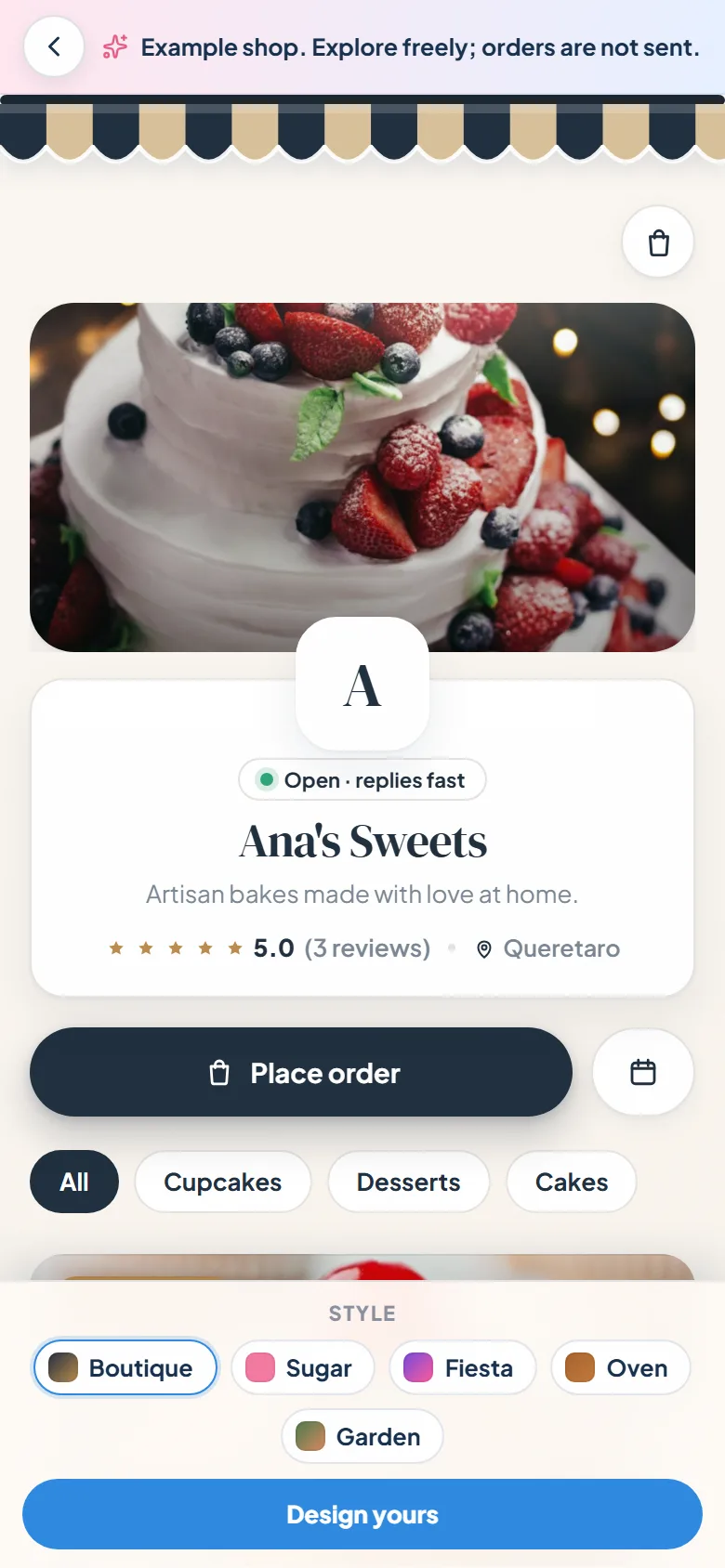
This is what your customer sees when they tap the link: your products with prices, your schedule, and your questions built into ordering. Nothing to install, no account to create.
A Confita shop is $4.99/month flat with no commission, and shop setup is free, so trying it costs you an afternoon.
Put a real menu behind your bio link
Set up your products, order questions, and deposit policy in an afternoon. Shop setup is free; the Pro trial starts when you activate live features.
Frequently asked questions
Where can I sell my baked goods online?
The realistic channels are your own shop link, Instagram and Facebook, local groups like Nextdoor, and marketplaces, usually two or three together. Social is where people discover you; the link is where order details get collected. Marketplaces add traffic but take a cut and own the customer relationship.
Do I need a website to sell baked goods?
Not a full website with hosting and plugins. You need one page that shows products, prices, and your order questions, which is what a shop link is. A full website makes sense later, when you want search traffic and a brand home, and even then the shop link usually stays on as the ordering layer.
Can I sell baked goods on Instagram?
Instagram is excellent for finding customers and terrible at collecting orders. Post there, build the audience there, but send buyers to a link that captures the date, quantity, flavors, and payment details in one step. Bakers who run whole orders in DMs hit a ceiling at a handful of orders a week.
Can I ship baked goods to other states?
Usually not under cottage food laws, which in most states limit you to in-state and often direct-to-consumer sales. Interstate shipping generally requires a licensed commercial kitchen and extra compliance. Check your state’s program before promising shipping, and build the local business first either way.