The template
Tap the button to copy the whole form as plain text, then paste it into a document, a message, or your form builder.
What makes a bakery order form work
A bakery order form has one job: turn “can I get some stuff for Saturday?” into lines you can bake from. That takes three groups of fields, the contact, the order itself, and the money, with nothing fuzzy left over.
Contact and dates come first. The “needed by” date is the field that saves you, because it lets you check your week before you promise anything. If Saturday is already full, you say so in the first reply, not after the butter is creamed.
The item lines do quiet work. Writing each item with a quantity and a unit price means the customer watches the math build as the order grows. Sticker shock happens when a total appears out of nowhere. It does not happen when someone sees three dozen cookies at $14 a dozen add up line by line.
The totals block, subtotal, deposit, and balance due with its date, is what separates an order form from a wish list. An order with a deposit and a due date is a booking. An order without them is a hope.
Keep the allergy and notes lines even when the order is just bread. The day you skip them is the day a sesame allergy shows up.
Weekly orders and standing customers
If you bake the same menu every week, sourdough on Fridays, cinnamon rolls on weekends, you do not need a fresh form each time. Turn the template into a weekly order sheet: your standing menu down the left with prices printed, quantity boxes beside each item, and a cutoff line such as “Orders close Wednesday 8 p.m. for Friday pickup.”
Standing customers get the same sheet with their usuals pre-filled. If Maria takes two sourdough loaves every Friday at $9 each, her sheet already says so and she only writes the changes. You know your bake quantities by Wednesday night, customers stop messaging “what do you have this week?”, and your flour order stops being a guess.
Pickup windows finish the job. Two printed windows, like Friday 4 to 6 p.m. and Saturday 9 to 11 a.m., beat twenty separate “what time?” threads.
Printable vs online
Both formats earn their keep, and many bakers run both: paper at the market table, a link everywhere else.
Paper never runs out of battery and nobody needs a link at a market stall. Online wins the moment orders come from people who are not standing in front of you.
| What matters | Printable form | Online form or shop link |
|---|---|---|
| Cost | Printing only | Free for form builders, $4.99/month for a Confita shop |
| Best at | Markets, pickups, regulars who like paper | Social media bios and group chats |
| When the order arrives | When you collect the sheet | In your inbox the moment it is sent |
| Math and totals | Done by hand, easy to slip | Added up for you |
| Menu and photos | Only what you print | Real product photos with prices |
Or skip the form: give customers a shop
A form still makes the customer do the writing. A shop link flips that: your items sit there with photos and prices, customers tap what they want, answer your questions, and the order lands in your inbox already itemized.
Confita is that link. Products with your own questions, a schedule with capacity limits so Saturday cannot overbook itself, and private quotes with deposits for custom work. It is $4.99/month after a 30-day free trial, and your customers never install anything.
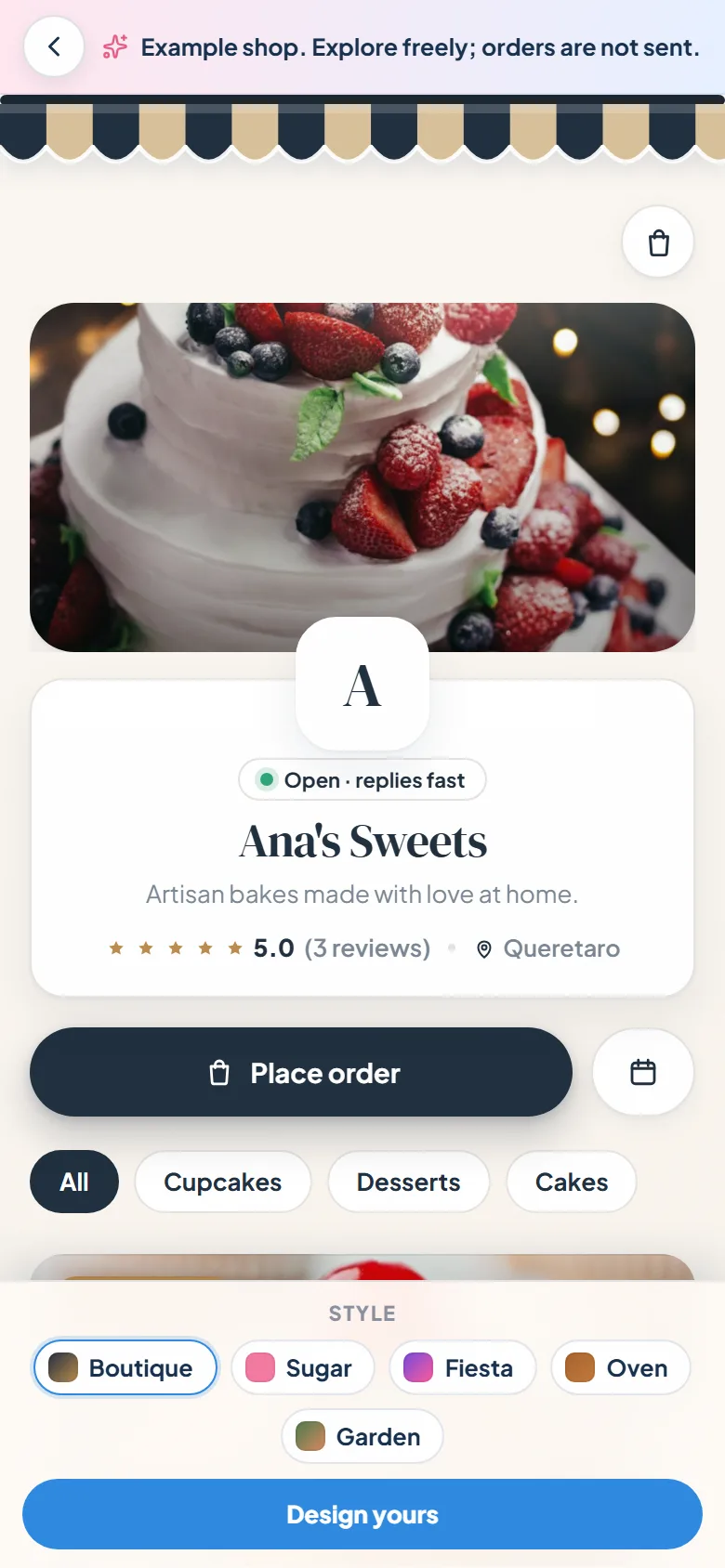
Turn this form into your shop link
Confita turns these fields into products and questions on one link customers open in the browser. 30 days free, no card today.
Frequently asked questions
What should a bakery order form include?
Customer name and contact, the date the order is needed, pickup or delivery, each item with quantity and unit price, a subtotal, deposit and balance due lines, the payment method, and a notes line for allergies. The template above covers all of it.
Is there a free bakery order form template?
Yes, the one at the top of this page. Copy it as plain text into a document or a message, or print it for your market table. No signup and no email are needed.
Should I take deposits on bakery orders?
For large or custom orders, yes. A 50% deposit reserves the date and covers ingredients if plans change. For small weekly orders of bread or cookies, most bakers skip the deposit and rely on the order cutoff instead.
How do home bakeries take orders online?
Most start in DMs, which works until the back-and-forth eats the week. A free form builder collects answers in one place. A shop link goes one step further by showing prices and photos and carrying deposits and payment details, which is the job Confita does for $4.99 a month.