Stripe and Square in Confita
This comparison is about the Confita connection, not every product either provider sells.
| Stripe | Square | |
|---|---|---|
| Bring an existing account | Eligible Standard accounts | Existing Square seller accounts |
| New-account path | Connected Express onboarding | Create the seller account with Square, then connect |
| Customer checkout | Stripe-hosted Checkout | Square-hosted checkout |
| Charge or payment belongs to | Connected Stripe account | Connected Square account and selected location |
| Confita platform fee | 0% | 0% |
| Best existing signal | Online payments already run through Stripe | Market or counter payments already run through Square |
Published US rates checked August 30, 2026. Actual rates vary by country, card origin, currency conversion, Square plan, and custom pricing. Check your provider dashboard for your rate.
Changing processors does not rebuild the bakery order
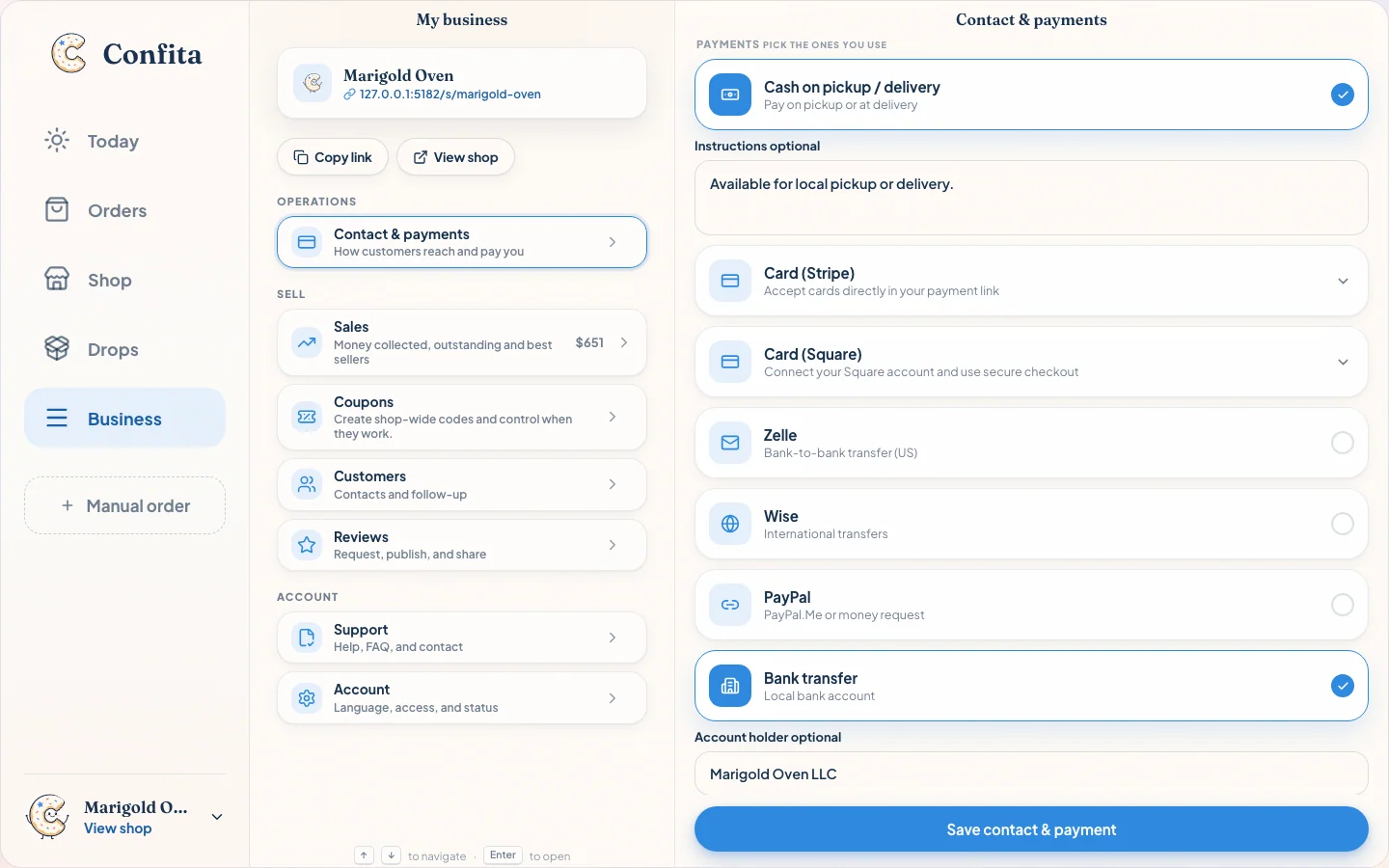
The products, custom questions, pickup details, quote, and payment status stay in Confita. Stripe or Square handles the hosted card page and records the payment in the account you connected.
Choose Square when the reader is already on your counter
Square gives an in-person seller a familiar account, dashboard, payout settings, and location structure. Connect that account to Confita, choose the eligible location for online bakery payments, and keep managing payments and payouts in Square.
Do not assume the market-stall tap rate follows the account into online checkout. The online card is a different transaction channel. Account continuity saves administrative work; it does not erase channel pricing.
Choose Stripe when the online business already lives there
If wholesale, invoices, or another online sales flow already uses an eligible Stripe Standard account, connecting it can keep online payment reporting in one place. Confita creates direct charges on the connected account and adds no application fee.
If you do not have Stripe, Confita can start a connected Express onboarding flow. That is a provider account for the bakery, not a Confita wallet.
Published US rates happen to match in one channel
Stripe’s standard US domestic online-card rate and Square’s published US Online API rate are each 2.9% + $0.30 at the time of this review. On $100, each example produces a $3.20 processing fee. When the payment goes through your own Stripe or Square account, Confita adds $0.
That does not make real-world pricing identical. Square plans and channels differ. Stripe adds fees for some international and currency-conversion cases. Both providers may offer custom pricing. Country and card mix matter. Open both dashboards and compare the rate your bakery can actually get.
| $100 published US online example | Stripe | Square |
|---|---|---|
| Provider rate | 2.9% + $0.30 | 2.9% + $0.30 Online API |
| Provider fee | $3.20 | $3.20 |
| Confita platform fee | $0.00 | $0.00 |
The operational tradeoff
Reasons to keep the account you have
- One less provider login and compliance profile to maintain.
- Familiar dashboard, payout settings, and reconciliation habits.
- New online payments stay in the dashboard you already reconcile.
Reasons to compare before connecting
- Your online rate may differ from your in-person rate.
- An existing Stripe account may not be eligible for OAuth connection.
- Square location, country, and currency eligibility still need to match.
The short answer
Already use Square at the farmers’ market? Start with Square. Already use an eligible Stripe account online? Start with Stripe. Starting from zero? Compare actual rates, country support, payout controls, disputes, and the dashboard you want to open every week.
The processor should fit the business you have. When payments go through your own Stripe or Square account, Confita connects it to a cleaner bakery order flow without adding a fee.
Go one level deeper
Frequently asked questions
Is Stripe or Square cheaper for online bakery payments?
Neither is always cheaper. Their published US online examples can match at 2.9% + $0.30, but country, card origin, currency conversion, Square plan, transaction channel, and custom pricing can change the result. Compare the actual pricing in your account.
Should I use Square if I already use it at farmers’ markets?
Usually it is the practical first option because you keep the Square seller account, selected location, dashboard, and transfer settings you know. The online checkout can have a different rate from card-present reader sales.
Can I connect Stripe and Square at the same time?
You can keep both connected to the shop, with one active for customer card checkout at a time. Customers see the active processor rather than two competing card options.
Does Confita take a percentage with either provider?
When payments go through your own Stripe or Square account, Confita adds no fee, you settle directly with your customer, and the active provider charges its applicable processing and account-specific fees.
Sources
Details were checked against public sources on August 30, 2026. Confirm current prices, policies, or provider instructions before relying on them.